
Types of Scaffolding: Every Kind Used in Construction, Explained
Follow one busy day on a building site, and learn every type of scaffolding without opening a boring textbook.
It is 7:40 in the morning. Ravi, a site supervisor in Pune, is standing at the gate of a half-built apartment block. Ten floors of bare concrete rise above him. His phone buzzes. It is his boss, and the message is short: “Scaffolding for tomorrow. Which type? Reply fast.”
Ravi has seen scaffolding all his life. But choosing it? That is new. He is about to find out that there is not one kind of scaffold. There are many. (Ravi is made up, but every problem he meets in this story is a real one from real sites.)
Stay with him. By the end, you will know all the types of scaffolding in construction, and you will be able to answer that same text message with confidence.
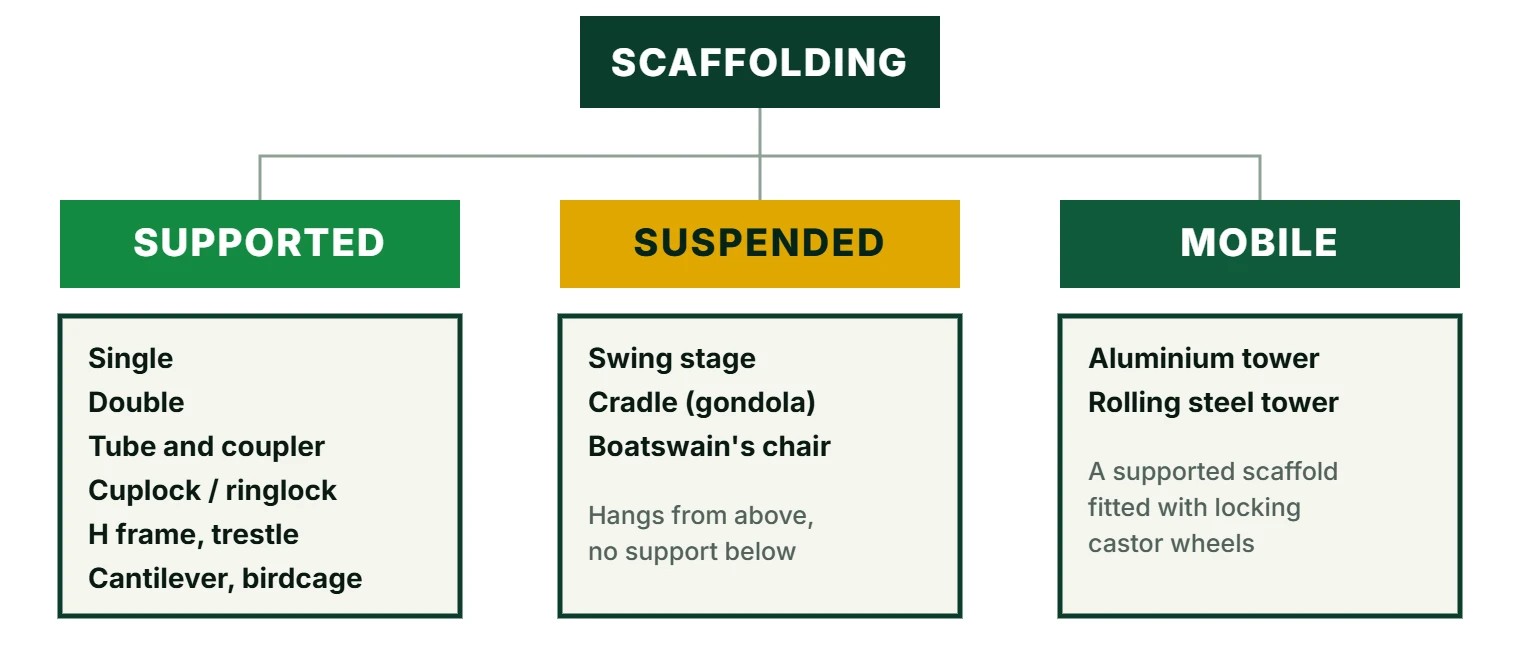
There are three types of scaffolding: supported, suspended and mobile (rolling). Inside those three you will find the kinds people name on site: single, double, tube and coupler, cuplock, frame, aluminium tower, cradle, cantilever, trestle and birdcage.
Scene 1 · 8:00 AM
How many types of scaffolding are there?
Ravi calls his old friend Imran, who has put up scaffolds for twenty years. “Imran, how many types of scaffolding are there?”
Imran laughs. “Ask a student and he will say three. Ask a crew on site and they will say twelve. Both are right.”
Then he explains the three types of scaffolding with things you already know from home:
- Supported scaffolding is like a table. It stands on the ground on its own legs. Most scaffolds you see on the road are this kind.
- Suspended scaffolding is like a swing basket on a hook. It hangs from above, so nothing stands underneath it.
- Mobile (rolling) scaffolding is like a table with wheels. You push it to the next work spot.
“Everything else,” says Imran, “is just a different version of those three.”
You can also sort scaffolds by material. Steel is the usual choice. Aluminium is used when weight matters. Bamboo is still common in some parts of Asia.
Scene 2 · 8:30 AM
Supported scaffolding types: single, double and tube and coupler
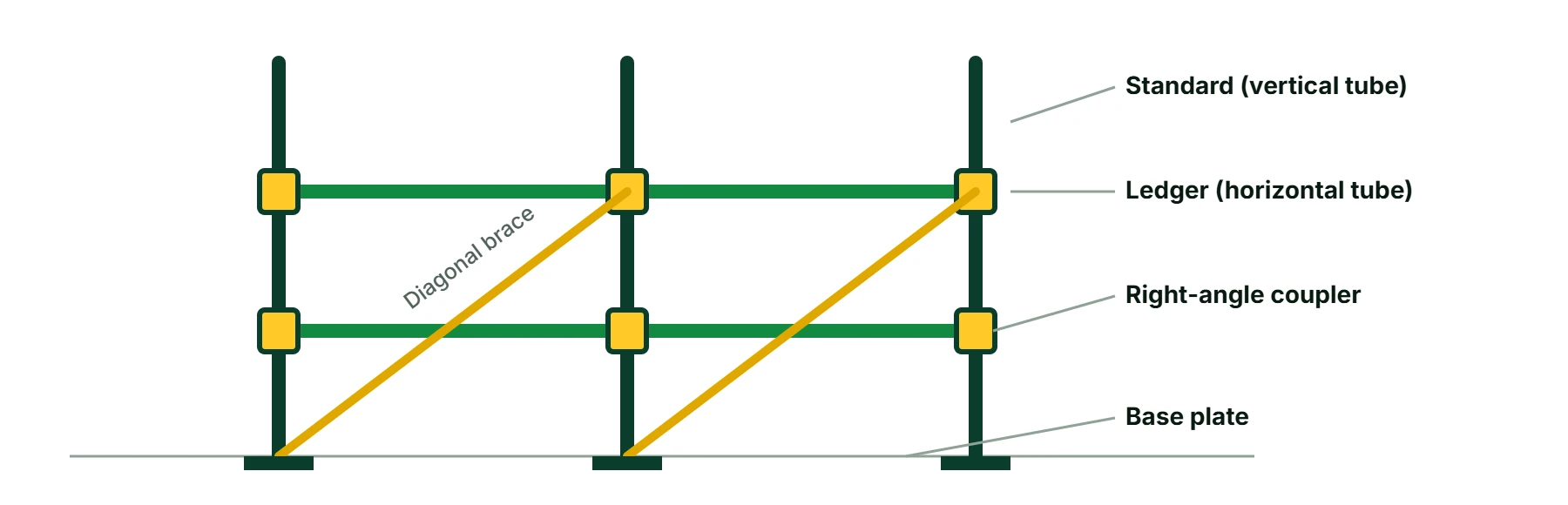
The ground floor of Ravi’s building has brick walls. So Imran starts with the oldest of the scaffolding types. All supported scaffolds pass their weight down to the ground through upright tubes called standards.
Single scaffolding
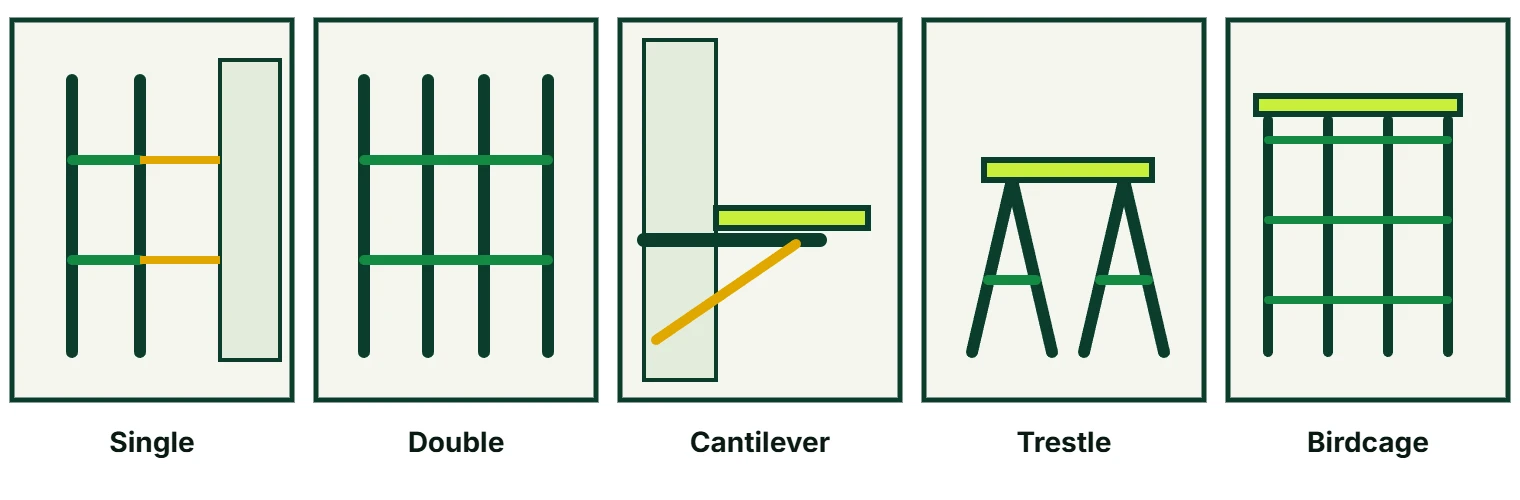
Picture one row of poles standing close to the wall. Long tubes called ledgers run along them. Short pieces called putlogs go from the ledgers into the wall. That is it. Single scaffolding is light and fast, and it is perfect for brickwork on low and mid-rise buildings. The catch? It leans on the wall, so the wall must be strong enough to take it.
Double scaffolding
Now picture two rows of poles. This scaffold stands on its own and does not need the wall at all. That is why crews use it for stone work and heavy repairs. It uses more material, but it can carry more weight and more people.
Tube and coupler scaffolding
This one is like a big metal construction set. You take plain steel tubes and join them with metal clamps. You can build almost any shape: a curved wall, a chimney, a tricky corner. The price you pay is time, because every clamp is tightened by hand. This is also why many people search for types of scaffolding clamps. Do not worry, we cover those in Scene 8.
Scene 3 · 9:15 AM
Cuplock and other system scaffolding
Now comes the big question: the ten-floor tower. Imran shakes his head. “For that height, forget loose clamps. Use cuplock.”
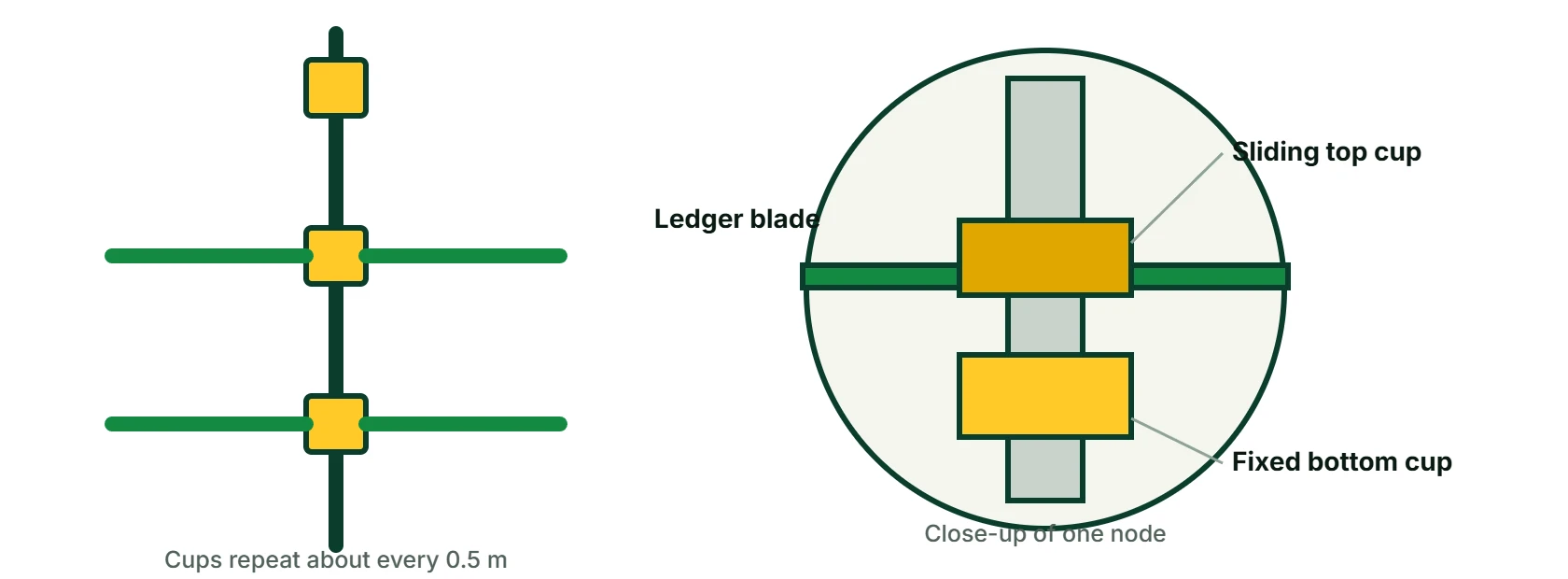
Think of cuplock as Lego for builders. Every upright pole has little steel cups welded on at fixed spots, usually every half metre. A ledger end drops into a cup. Then you slide the top cup down and tap it once with a hammer. Click. Locked. Up to four ledgers can meet in one cup.
Because every bay comes out the same size, the scaffold grows fast and it is easy to count and check. That is why cuplock is the first choice for tall tower facades, heavy slab shuttering and industrial plants. Ringlock and kwikstage work on the same idea with different connectors.
Want to see the parts and uses? Read our page on cuplock scaffolding on rent. If you want trained hands to put it up, look at our installation and dismantling service.
Scene 4 · 10:30 AM
H frame (frame) scaffolding
Next, Imran walks Ravi to the long compound wall. It needs plaster and paint. “No need for anything fancy here,” he says. “Use H frames.”
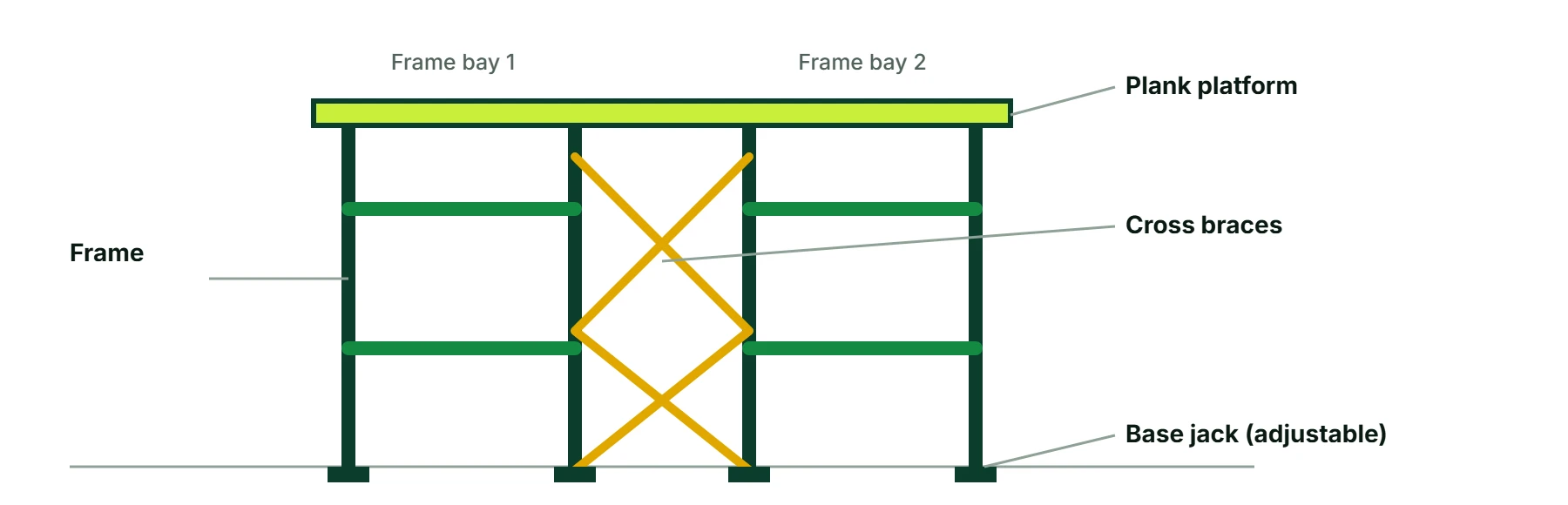
Frame scaffolding is made from ready-made steel frames, shaped like the letter H or a door. You join them with cross braces and lay planks on top. Nothing needs measuring. A crew can raise one bay in minutes, then slide along the wall and do it again. It is cheap, quick and easy to count, so it is a favourite for plaster, putty and paint on straight walls and low or mid-rise buildings.
The limit is shape and height. Frames love straight walls and medium heights. They are not for curves or heavy slab loads. You can check sizes and uses on our H frame scaffolding page.
Scene 5 · 11:45 AM
Mobile scaffolding and aluminium towers
Inside the building there is a showroom with shiny polished floors. The lights need fixing. Ravi imagines a heavy steel scaffold scratching that floor and winces.
“Use an aluminium tower,” says Imran. “It is light. It rolls.”
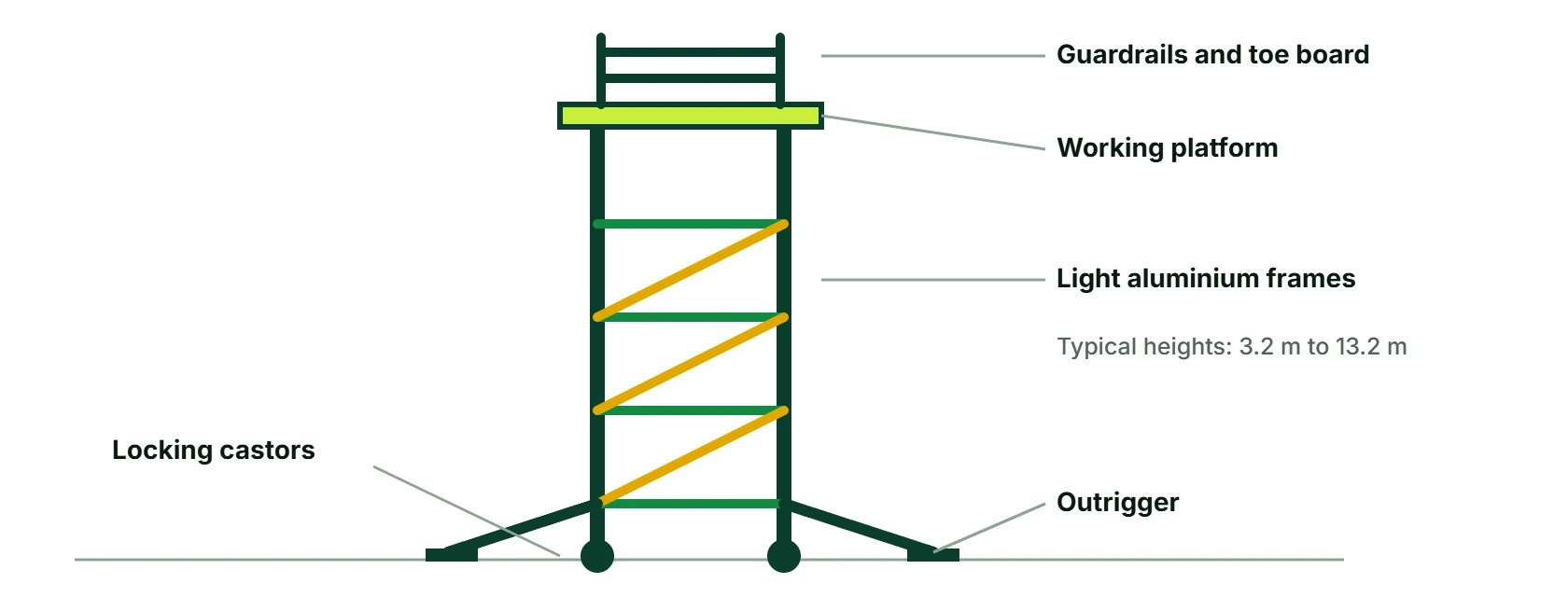
That is mobile scaffolding. It is a supported scaffold with castor wheels that lock when you stop. The most common kind is the aluminium scaffold tower. Two people can build it and move it, even on upper floors. It does not rust, and the wheels are kind to finished floors. Heights from 3.2 m to 13.2 m cover most indoor jobs, which is why you see towers in malls, offices, factories, hotels and metro stations.
Two golden rules: never move the tower with someone standing on it, and always lock the wheels before anyone climbs. Tall towers also need outriggers to widen the base. Sizes are on our aluminium scaffolding on rent page.
Scene 6 · 1:00 PM
Suspended scaffolding
After lunch, Ravi looks across the road. A glass tower stands there, and a small platform is sliding slowly down its face, with two workers on it and nothing underneath. His stomach drops a little.
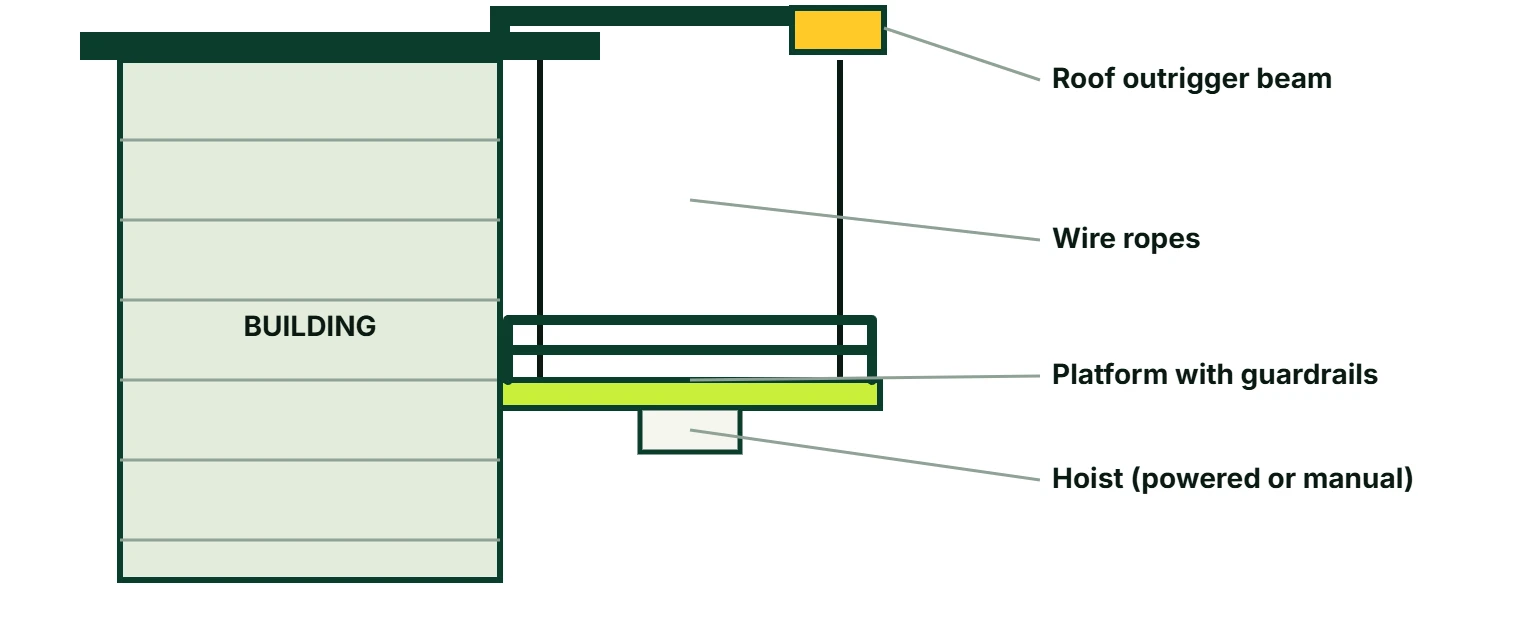
“Suspended scaffolding,” says Imran. “It hangs from the roof on steel wire ropes. You will hear names like swing stage, cradle, gondola and boatswain’s chair, which is a seat for one person.”
It is used to clean glass, paint and seal tall facades, or to do repairs where building a scaffold from the ground would take too long. The platform is only as safe as its roof anchor, so the beams, counterweights and ropes must be checked before every shift. And this is a job for trained operators, never a do-it-yourself rental.
Scene 7 · 2:15 PM
Cantilever, trestle and birdcage scaffolding
Every toolbox has a few odd tools for odd jobs. Scaffolding has three.
- Cantilever scaffolding works like a balcony. It rests on beams, called needles, that stick out through the wall or from a lower floor. Crews use it when the ground cannot take poles, for example over a busy road or a deep pit.
- Trestle scaffolding works like a painter’s stool. A low platform sits on A-frames. It is the easiest way to reach the ceiling of an ordinary room.
- Birdcage scaffolding looks like a forest of poles. A tight grid of standards and ledgers fills the whole floor, so crews can work on the high ceiling of a hall or a factory.
Planning a stage, seating or a temporary structure? That is a different job again. See our event scaffolding page.
Scene 8 · 3:30 PM
Types of scaffolding clamps (couplers)
Late afternoon. A worker holds up a small steel clamp and shows it to Ravi. It looks too small to matter.
“Small part, big job,” says Imran. “One wrong clamp at one joint, and a whole bay can shift.” So here are the types of scaffolding clamps in plain words:
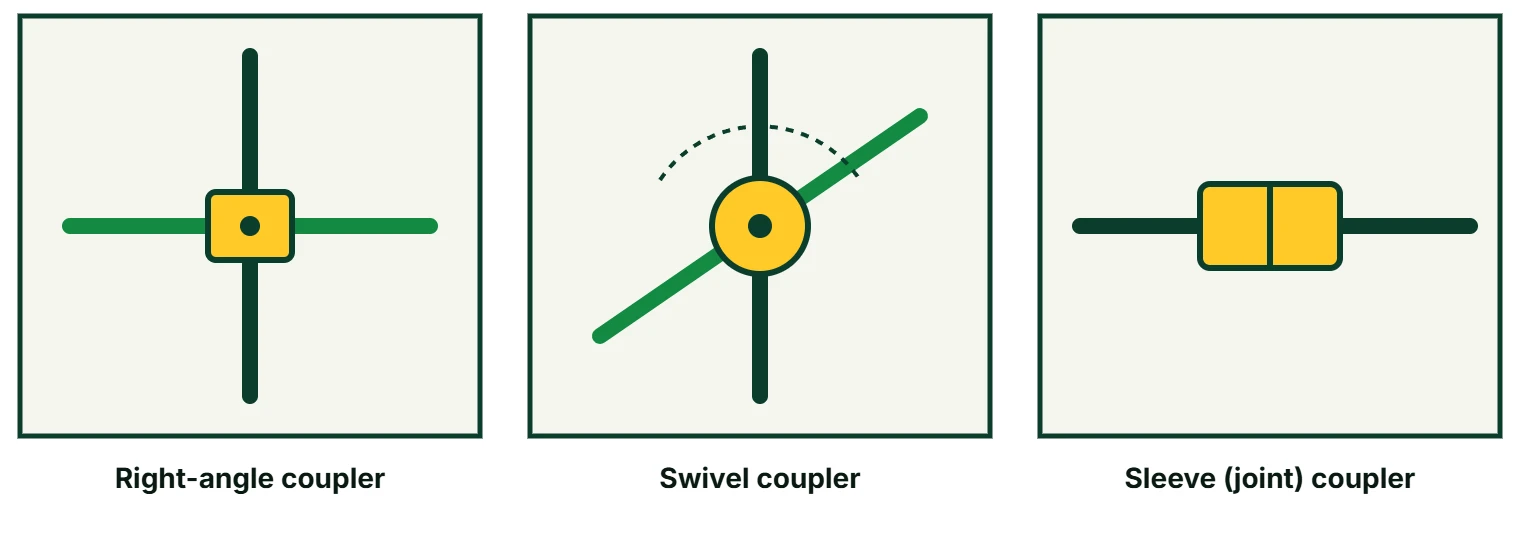
- Right-angle (double) coupler: joins two tubes at 90 degrees. It carries load, so it is used between standards and ledgers.
- Swivel coupler: joins two tubes at any angle. It is the clamp for diagonal braces.
- Sleeve (joint) coupler: joins two tubes end to end when one tube is too short.
- Putlog (single) coupler: fixes a putlog or transom to a ledger. It does not carry the standards.
- Girder (beam) coupler: grips a tube to the flange of a steel beam.
- Board retaining coupler: holds a toe board against a standard.
- Parallel coupler: joins two tubes side by side.
Couplers come in different load classes, so always read the marking and check which standard they were made to. Around the world, couplers follow standards like EN 74 and BS 1139, and in India, steel scaffolding practice is covered by IS 2750 and IS 4014. Whichever types of scaffolding couplers you pick, they must match the load the joint will carry. Looking for tubes and fittings? See our scaffolding material name list for every part and its use, or start with our page on scaffolding and shuttering materials.
Scene 9 · 4:30 PM
Scaffolding bracing types
As the sun goes down, the wind picks up. Ravi watches a tall scaffold on the next plot and thinks it looks a little wobbly.
“That is what happens with weak bracing,” says Imran. “Without bracing, a scaffold is just a set of tall thin tubes. Push it sideways and it folds, like a ruler standing on a table.” Bracing is what stops sway, and it is not optional. These are the scaffolding bracing types you will see on an inspection sheet:
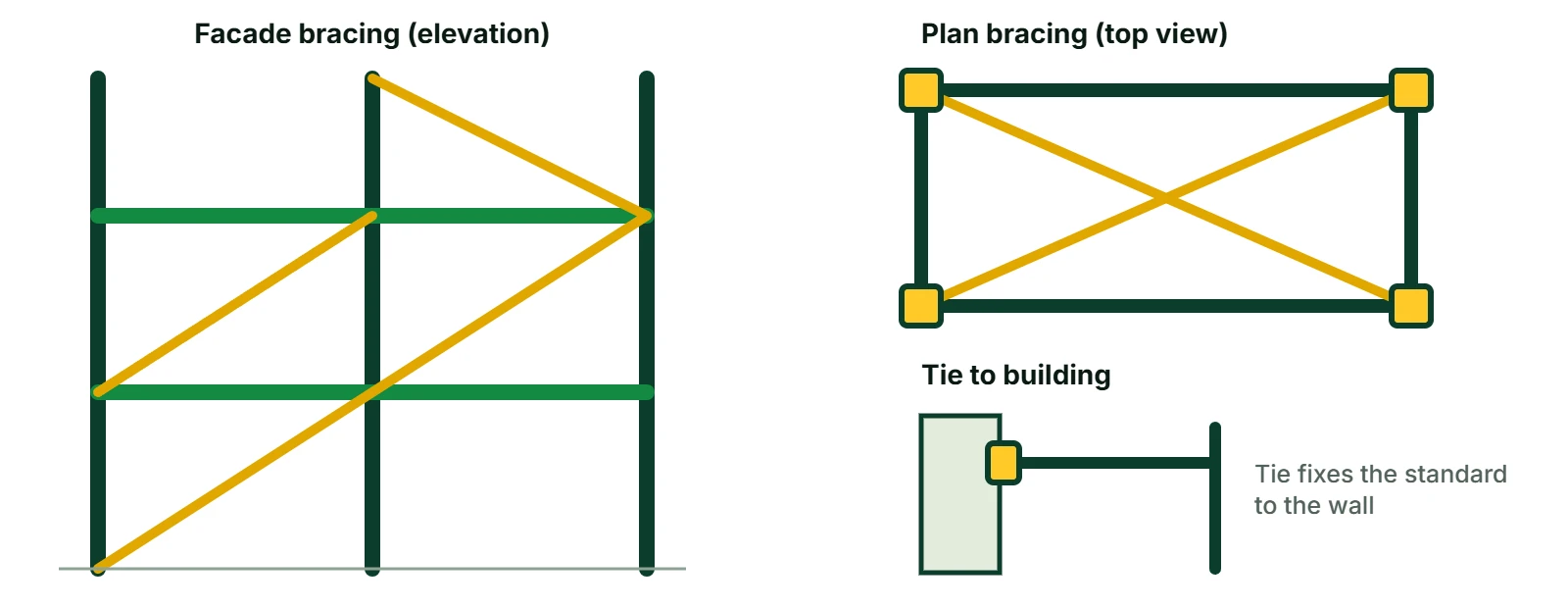
- Facade (face) bracing: diagonals on the outer face. They stop sway along the length.
- Ledger bracing: diagonals in the long direction that keep the ledgers rigid.
- Cross (transverse) bracing: diagonals across the width. They stop the scaffold from tilting front to back.
- Plan bracing: flat diagonals at platform level that keep the layout square.
- Ties: not braces exactly, but they fix the scaffold to the building so it cannot fall outward.
In cuplock and frame systems, bracing usually comes ready-made. In tube and coupler work, it is a tube fixed with swivel couplers. Either way, fit it as the scaffold goes up. Never “add it later”.
Scene 10 · 5:15 PM
Different types of scaffolding compared
Before leaving, Imran scribbles a cheat sheet on the back of a cement bag. We have cleaned it up for you. It puts the different types of scaffolding side by side.
| Type | Group | Best for | Main limit |
|---|---|---|---|
| Single | Supported | Light brickwork | Needs a wall that can take putlogs |
| Double | Supported | Stone masonry, heavy repairs | More material and time |
| Tube and coupler | Supported | Curves, chimneys, odd shapes | Slow, depends on crew skill |
| Cuplock / ringlock | Supported | Tall towers, slab shuttering | Heavier parts to handle |
| H frame | Supported | Plaster and paint on straight walls | Not for curves or heavy loads |
| Aluminium tower | Mobile | Interiors, finished floors | Small platform, limited load |
| Cradle / swing stage | Suspended | Facade cleaning and painting | Needs trained operators |
| Cantilever | Supported | No access from the ground | Needs a strong structure for the needles |
| Trestle | Supported | Low interior finishing | Low heights only |
| Birdcage | Supported | High ceilings over wide areas | Lots of material |
Scene 11 · 6:00 PM
How to choose the right type of scaffolding
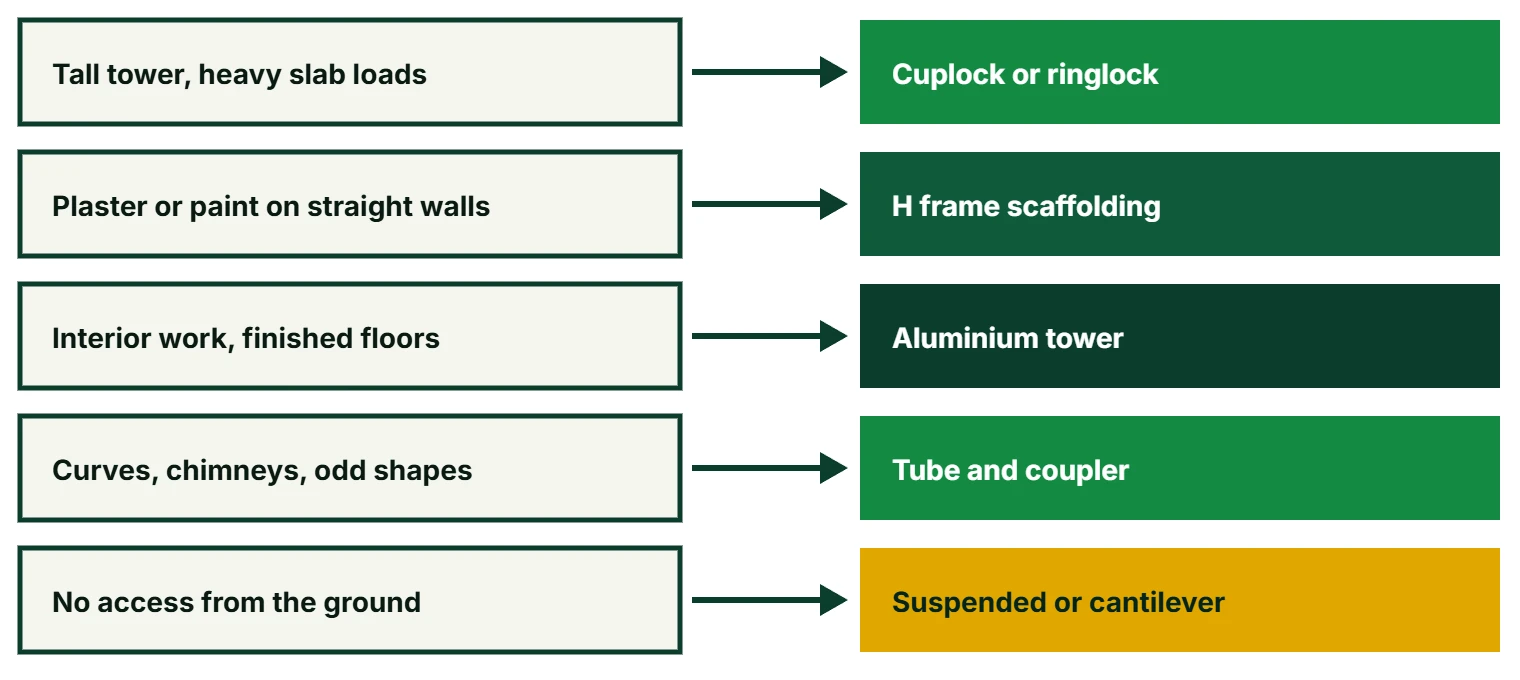
Now Ravi can finally answer his boss. But how does he decide? Imran gives him four simple questions. How high is the work? How heavy is the load? What shape is the building? Can you reach it from the ground?
Tall tower with heavy slabs? Cuplock. Plastered boundary wall? H frames. Office with polished floors? Aluminium tower. Glass facade with no access at the bottom? A suspended platform.
One more tip: for a single project, hiring is usually cheaper than buying. Rental period, transport and crew support all change the final price. Our guide to hiring scaffolding lists the questions to ask a supplier, and the scaffolding on rent page shows every system we supply.
Safety rules that apply to every type
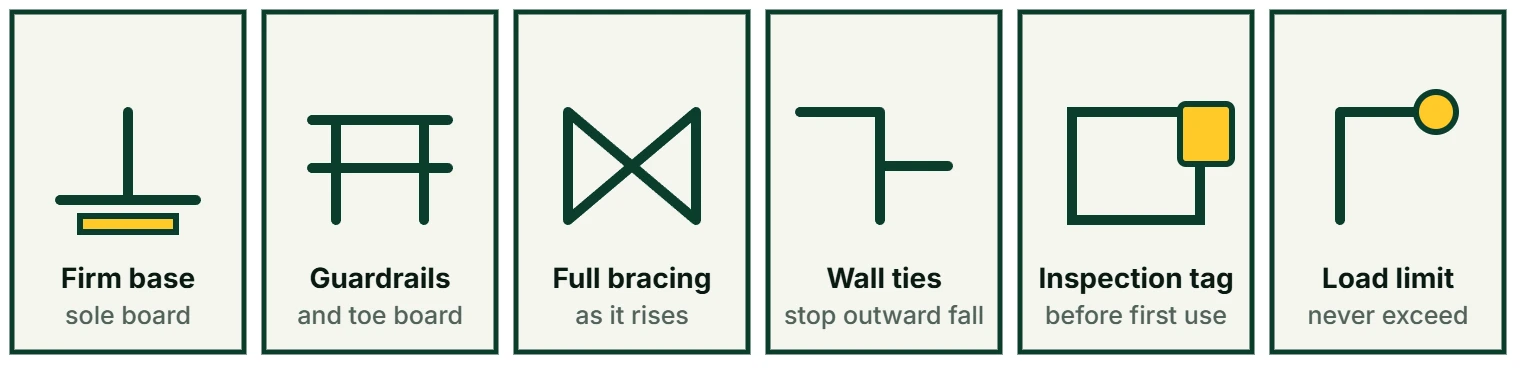
Whatever Ravi picks, the same basics apply: a firm base or sole boards, full bracing, ties where needed, fully planked platforms, guardrails and toe boards, and an inspection before first use and after bad weather. In India, the useful references are IS 2750 for steel scaffoldings, IS 4014 for steel tubular scaffolding practice and IS 3696 for the safety code for scaffolds and ladders. Follow your project safety rules too, and let a competent person approve the layout of any tall or complex scaffold.
Types of scaffolding PDF: take Ravi’s cheat sheet with you
Want the whole story on one page? We turned the groups, types, couplers and bracing into a one-page file that prints cleanly. It is handy for site inductions and for comparing quotes.
Download the types of scaffolding PDF
Bonus scene
Frequently asked questions
What are the 3 types of scaffolding?
The three types of scaffolding are supported, suspended and mobile (rolling). Supported scaffolds stand on the ground, suspended ones hang from above, and mobile ones are supported scaffolds on wheels.
How many types of scaffolding are there in total?
There is no single fixed number. There are three main families, and on real projects you will meet about ten to twelve specific types, including single, double, tube and coupler, cuplock, frame, aluminium tower, cradle, cantilever, trestle and birdcage.
Which type of scaffolding is used most in construction?
Supported scaffolding is the most widely used. Within it, system scaffolding such as cuplock is common on large projects, while tube and coupler and H frames are common on smaller or irregular jobs.
What are the main types of scaffolding clamps?
The main types of scaffolding clamps are right-angle (double) couplers, swivel couplers and sleeve couplers. Putlog, girder, board retaining and parallel couplers do more specific jobs.
What are the types of bracing in scaffolding?
The common types are facade bracing, ledger bracing, cross (transverse) bracing and plan bracing, along with ties that anchor the scaffold to the building.
The next morning · 7:40 AM
The reply
Back at the gate, a new day. Ravi types his answer to his boss: “Cuplock for the tower. H frames for the compound wall. One aluminium tower for the showroom. Please get quotes.” He presses send, looks up at the ten bare floors and, for the first time, smiles. He knows exactly what will stand there tomorrow.
Your turn. Need scaffolding for your site?
Tell us the city, the working height and the date you need the material. We will send a written quote that lists the items, rental period, transport and crew support. Our yard is in Moshi, Pimpri-Chinchwad, so Pune sites are our fastest delivery zone, and we send material by road to other cities such as Mumbai and Delhi NCR. See scaffolding on rent in Pune, or contact us with your site details.