
Scaffolding Material Name List: Every Part, Its Use and HSN Code
The simple guide to scaffolding material. Learn the name of every part, what it does and what to check before you buy or hire.
Ask for “scaffolding material” at a yard, and the first question you will hear is, “Which part?” Standards, ledgers, jacks, couplers, planks. The names sound like a foreign language, until someone explains them.
So here it is. This is a plain scaffolding material name list with a simple line about each part, a look at the materials they are made from, a note on price and the HSN code, and a short checklist for quality. No jargon walls. If you only want the list, jump to the table and download the PDF.
Scaffolding material means all the parts used to build a scaffold. The main ones are standards (upright tubes), ledgers (horizontal tubes), diagonal braces, base jacks, couplers or cups, planks, toe boards, guardrails, ties and ladders. Most steel scaffolding equipment falls under HSN 7308 40 00.
What is scaffolding material?
Scaffolding material is everything you need to put up a temporary working platform at height. That includes the tubes and frames that carry the weight, the fittings that hold them together, the boards you stand on, and the safety parts such as guardrails and ties.
Different systems use different parts. A cuplock scaffold uses cups and ledgers. A tube and coupler scaffold uses plain tubes and clamps. An H frame scaffold uses ready-made frames. An aluminium tower uses light frames and castor wheels. If you are new to this, our guide to the types of scaffolding shows how each system works and where it fits.
Scaffolding material name list (with uses)
This table is the heart of the page. Treat it as your ready scaffolding material list: it shows the common parts, what each one does, and where you will find it. Keep it handy when you ask for a quote.
| Part name | What it does | Used in |
|---|---|---|
| Standard (upright) | Carries the load down to the ground | All systems |
| Ledger (horizontal) | Joins standards and sets the bay height | Cuplock, tube |
| Transom (cross tube) | Holds planks across the ledgers | Tube and coupler |
| Diagonal (facade) brace | Stops the scaffold swaying | All systems |
| Cross brace | Links two H frames together | H frame |
| Base plate | Spreads the load on the ground | All systems |
| Base jack | Sets level and height at the foot | Cuplock, frame |
| U-head jack | Carries beams or formwork at the top | Shuttering |
| Sole board | Plank under the base on soft ground | All systems |
| Scaffold tube (steel pipe) | The basic tube, usually 48.3 mm outer diameter | Tube and coupler |
| Right-angle coupler | Joins two tubes at 90 degrees | Tube and coupler |
| Swivel coupler | Joins two tubes at any angle | Tube and coupler |
| Sleeve coupler / joint pin | Joins two tubes end to end | Tube and coupler |
| Cup (fixed and top cup) | Locks up to four ledgers at one node | Cuplock |
| H frame / ladder frame | Ready-made frame, no measuring | H frame |
| Steel plank (scaffold board) | The platform you walk and work on | All systems |
| Toe board | Stops tools and debris falling off | All systems |
| Guardrail (top and mid) | Stops people falling from the edge | All systems |
| Ladder or stair unit | Safe way up and down | All systems |
| Castor wheel and outrigger | Let a tower roll, lock and stay stable | Mobile tower |
| Wall tie | Fixes the scaffold to the building | All systems |
| Debris net | Catches falling debris and cuts wind | Facades |
Want it on paper? There is a two-page scaffolding material name list PDF further down.
Where each part sits on a finished scaffold
Names are easier to remember when you can see them. In the picture below, the upright tubes are standards, and the long green tubes are ledgers. The yellow diagonal is a brace. The plank at the top is the working deck, and the guardrail and toe board keep people and tools from falling off.
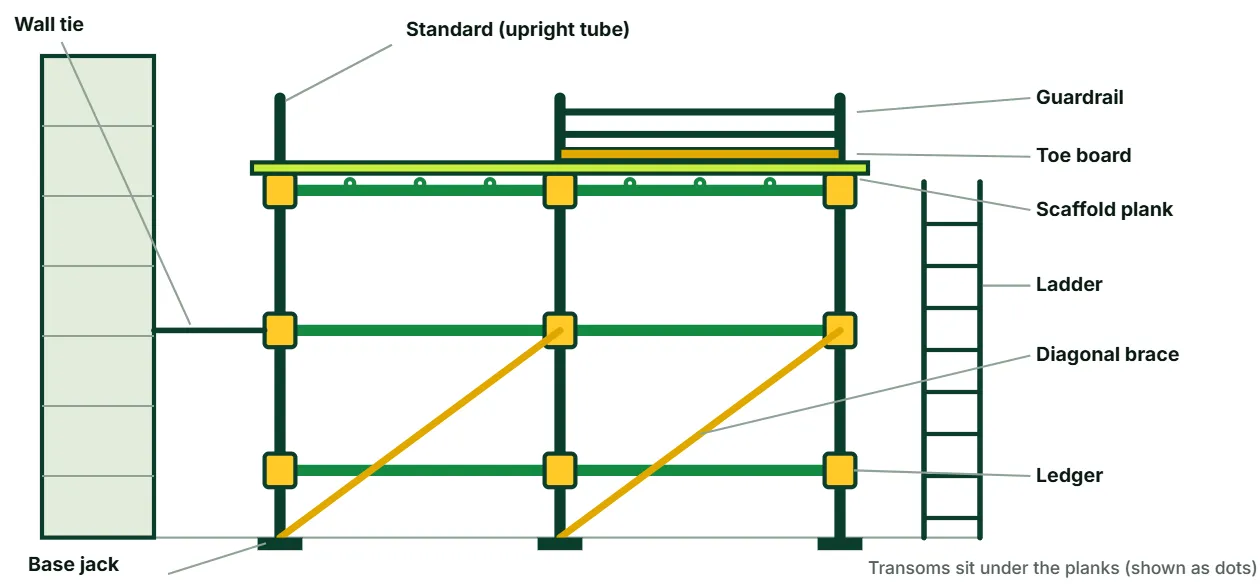
One more tip: the bottom of the scaffold matters most. A scaffold on soft ground needs a sole board under every base plate, and a tall scaffold needs wall ties at regular spacing. Missing these two small parts is behind many site problems.
Cuplock scaffolding materials
Cuplock is a system scaffold, so its parts are made to fit each other without loose clamps. A complete set includes standards with fixed cups, ledgers with blade ends, diagonal braces, base jacks, U-head jacks and steel planks. The top cup slides down and locks the ledgers at each node.
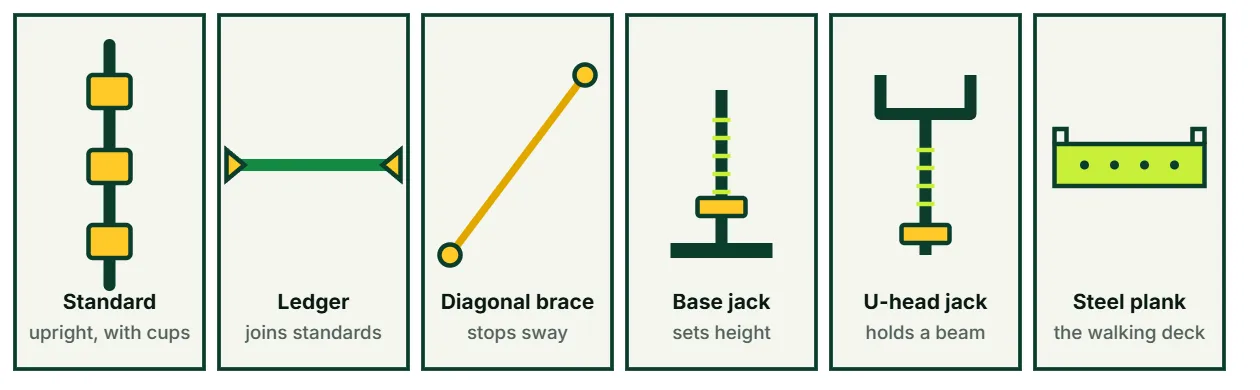
Because the parts are standard sizes, a cuplock set is easy to count when it arrives and when it goes back. You can see typical set contents and uses on our page for cuplock scaffolding on rent, and our installation and dismantling service can build it for you.
Tube and coupler scaffolding materials
Here the kit is simpler but the detail matters more. You need steel tubes, usually around 48.3 mm in outer diameter, plus couplers to join them. The right-angle coupler carries load between standards and ledgers. The swivel coupler joins diagonal braces at any angle. The sleeve coupler or a joint pin joins two tubes end to end. Base plates sit at the bottom.
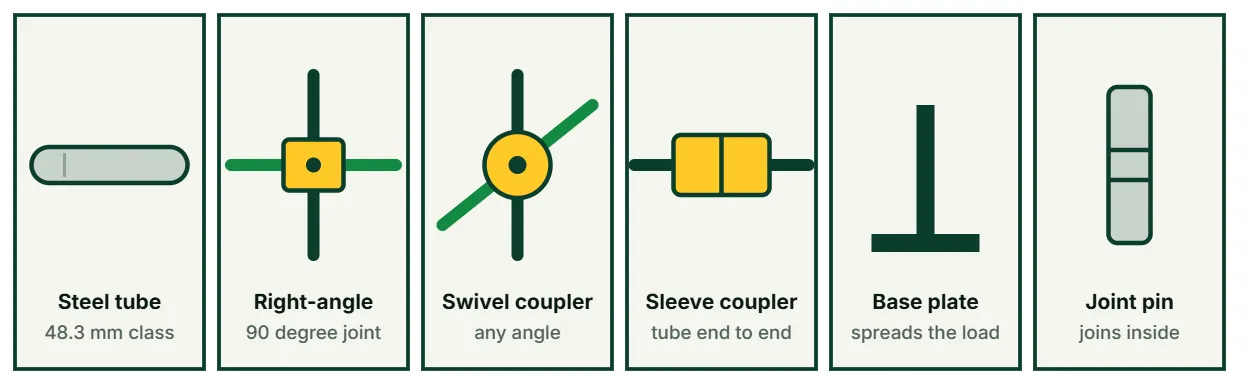
Couplers come in different load classes, so read the marking on each one. We explain the main clamps in more detail in our guide to the types of scaffolding clamps.
H frame and aluminium scaffolding parts
An H frame set is the shortest list of all. You need the frames, cross braces, base jacks, planks and a few pins. That is why crews love it for plaster and paint on straight walls. Details are on our H frame scaffolding page.
An aluminium tower has light frames, a platform with a hatch, guardrails, castor wheels and outriggers. Everything clips together by hand, which is why two people can build it. See sizes and heights on the aluminium scaffolding on rent page.
Materials hoist for scaffolding
On tall projects, carrying bricks, cement bags and tools up a ladder is slow and risky. A materials hoist lifts them instead. It has a mast, a car or platform that carries the load, a wire rope over a pulley, and a motor with a winch at the bottom. The mast is tied to the scaffold or the building, and a landing gate keeps people from stepping into the gap.
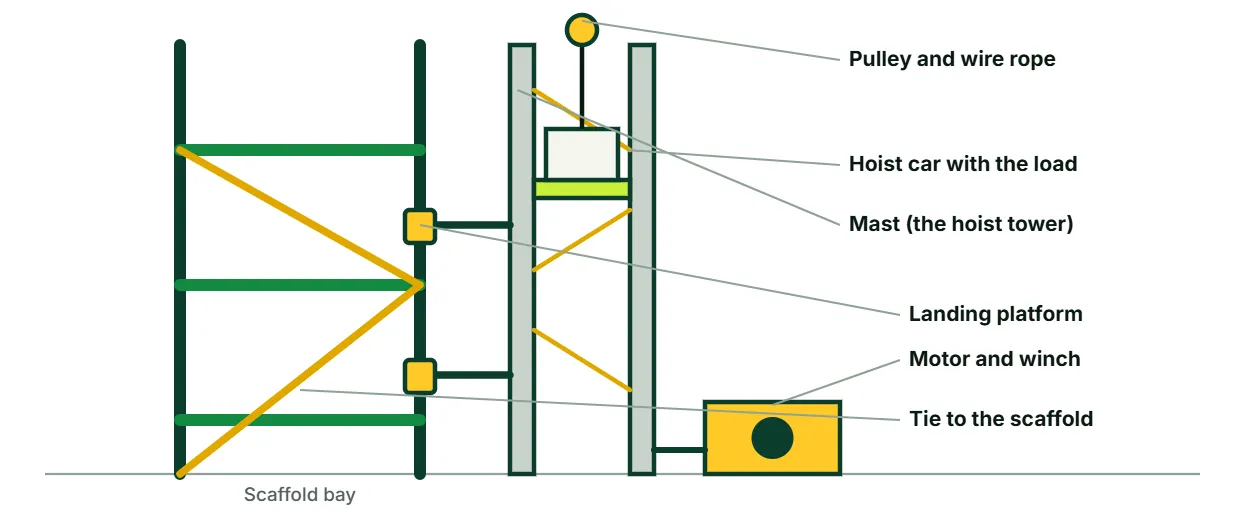
A hoist should only be run by a trained operator, and it must never carry people unless it is designed for that. Ask for the safe working load in writing before the first lift.
What is scaffolding material made of?
Most scaffolding material is steel, because it is strong and cheap. But the same part can be made in a few ways, and the choice changes how long it lasts and how it handles.
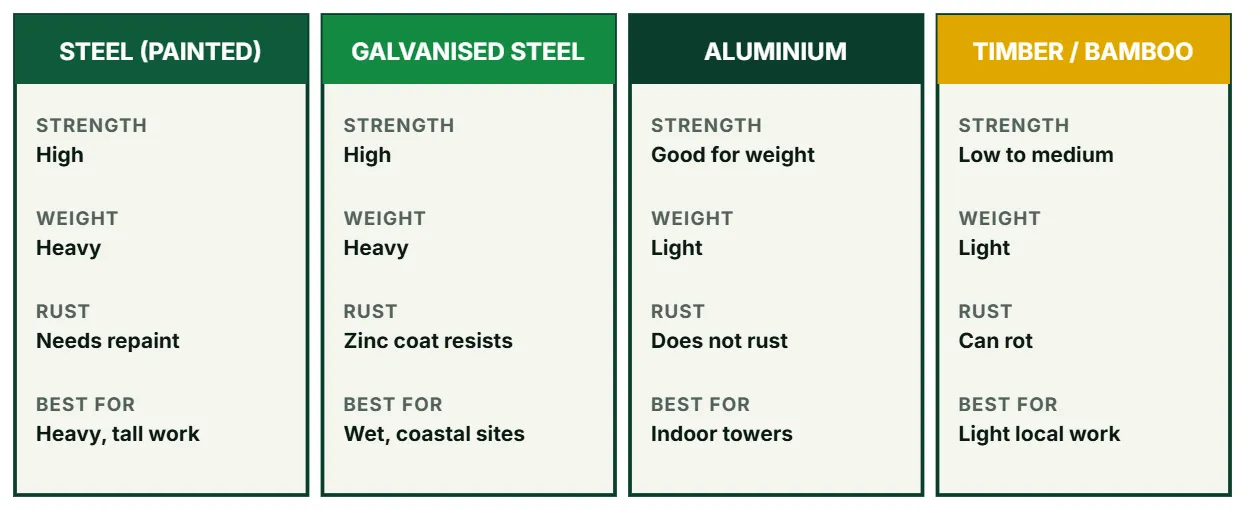
- Painted steel is strong and common. It needs repainting to fight rust.
- Galvanised steel has a zinc coat that resists rust, so it lasts longer in wet or coastal places.
- Aluminium is light and does not rust. It suits indoor towers and quick moves.
- Timber and bamboo are still used for light work in some places, but they can rot and vary in strength.
Scaffolding material price: what decides it
People often search for a single price. The honest answer is that there is no one price, because the cost depends on a few clear things:
- Weight and steel rate: steel parts are often priced by weight, so a heavier standard costs more.
- System and quantity: a cuplock set, an H frame set and an aluminium tower are priced differently.
- Coating: galvanised parts cost more than painted ones, but last longer.
- Buy or rent: for one project, renting is often cheaper. The rate then depends on the rental period.
- Transport and GST: delivery distance and tax are separate lines on the bill.
A simple way to estimate a rental: pieces needed × rate per piece × days or months, plus transport and GST. Not sure how many pieces? Our page on the scaffolding and shuttering materials we supply explains how to count, and our guide to hiring scaffolding lists the questions to ask before you pay.
Scaffolding material HSN code and GST
If you buy or sell scaffolding, you need the right HSN code on the invoice. This table is a quick guide.
| Item | Usual code |
|---|---|
| Steel equipment for scaffolding, shuttering and propping | HSN 7308 40 00 |
| Aluminium scaffolding equipment | HSN 7610 |
| Renting scaffolding (a service) | SAC 9973 |
Please note: tax rules and rates change, and some items may fall under a different code. Always confirm the current HSN code and GST rate with your chartered accountant before you invoice.
Quality checks for scaffolding material
Whether you buy or hire, look at the material before it leaves the yard. Six quick checks catch most problems:
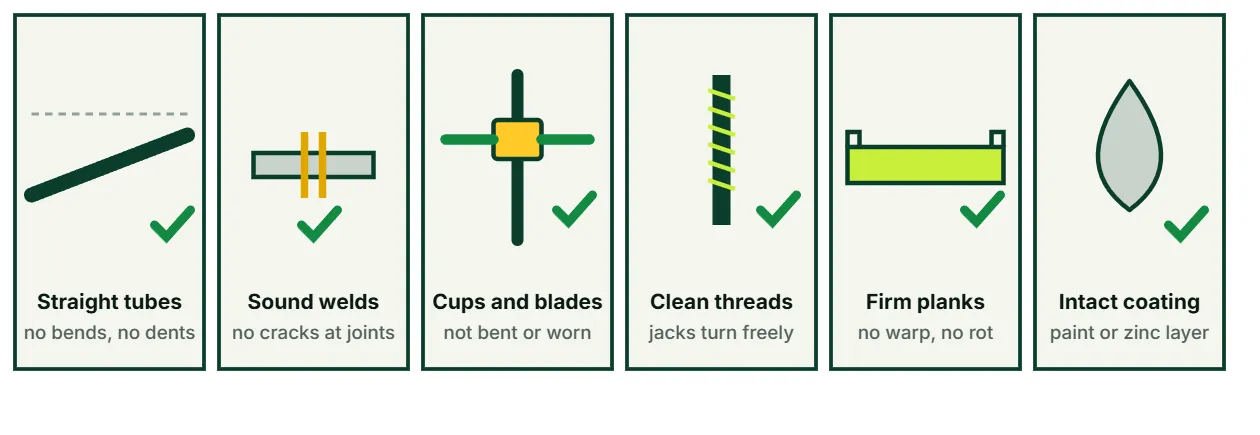
Reject any tube that is bent or dented, any weld with a crack, any cup or blade that is deformed, any jack that does not turn freely and any plank that is warped or soft. Steel scaffolding should follow Indian standards such as IS 2750 and IS 4014, and the safety code is IS 3696.
Scaffolding materials near me: where to get them
If you are in Pune or Pimpri-Chinchwad, our yard is in Moshi, so material can reach most sites quickly. We supply to areas such as Hinjewadi, Chakan and Chinchwad, and we send material by road to other cities. See scaffolding on rent in Pune for local details, or the full list of scaffolding on rent locations.
Scaffolding material name list PDF
We put the whole list, with uses and the HSN note, into a clean two-page file. It prints well, and it is useful for site stores and for comparing quotes.
Download the scaffolding material name list PDF
Frequently asked questions
What are the main materials used in scaffolding?
The main materials are steel tubes and frames, couplers or cups, base plates and jacks, planks, guardrails and ties. Steel is the most common metal. Aluminium is used for light towers, and timber or bamboo is used for light work in some places.
What is the name of the horizontal and vertical parts of scaffolding?
The vertical tubes are called standards (or uprights). The horizontal tubes along the length are called ledgers, and the cross tubes that hold the planks are called transoms.
What is the HSN code for scaffolding material?
Steel equipment for scaffolding, shuttering and propping is usually classified under HSN 7308 40 00. Aluminium scaffolding is usually under HSN 7610. Please confirm the current code and GST rate with your chartered accountant.
How much does scaffolding material cost?
There is no single price. It depends on the system, the weight of steel, the coating, the quantity, whether you buy or rent, the rental period, transport and GST. A written quote that lists every item is the best way to compare.
What size are scaffold tubes?
The common scaffold tube has an outer diameter of about 48.3 mm. Wall thickness and length vary, so always check the specification and the standard it was made to.
Need scaffolding material for your site?
Send us the city, the system, the quantity and the date you need it. We will reply with a written quote that lists every item, the rental period, the transport and any crew support. Call or WhatsApp us, or contact us with your site details.